Faced with the global plastic pollution crisis, a green revolution centered on "chemical recycling" is unfolding. This article provides an in-depth analysis of seven major advanced plastic recycling technology pathways and reveals how Europe, with over 1/3 of the world’s capacity, has become the leader in this transformation.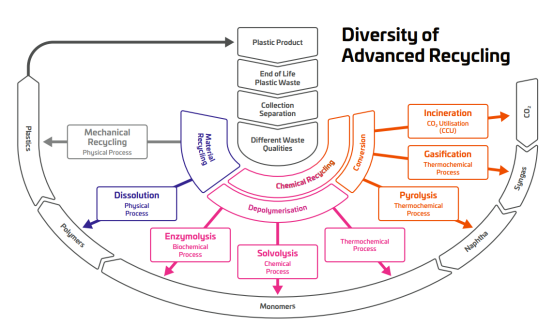
Hundreds of millions of tons of plastic waste are generated globally each year. Traditional mechanical recycling is powerless to handle mixed or contaminated plastics. Advanced plastic recycling technologies have emerged as a solution: they break down plastics "back to their original form" through chemical means, converting them into raw materials for manufacturing new plastics and truly realizing closed-loop circularity.
Industry reports show that more than 340 advanced waste plastic recycling plants are now in operation worldwide, with an annual processing capacity approaching 1.5 million tons.
The system of advanced waste plastic recycling technologies is becoming increasingly mature. The table below details and compares the core characteristics of mainstream technologies:
|
Technology Category |
Core Principle |
Applicable Plastic Types |
Output Products |
Representative Enterprises/Projects |
|
Pyrolysis - Cracking |
Thermal decomposition under oxygen-deficient, high-temperature conditions ( 400-800℃) |
Most thermoplastics such as PE, PP, PS |
Synthetic oil, naphtha, light hydrocarbons |
ExxonMobil Exxtend™, Shell BlueAlp, Vary Tech |
|
Hydrothermal Liquefaction |
Dissolution and cracking in supercritical water (≈400℃) |
Soft, composite, or contaminated plastics |
High-purity oil products, liquid fuels |
Mura HydroPRS™ |
|
Solvolysis/Dissolution |
Depolymerization of polymers into monomers using specific solvents |
PET, polyesters, polyamides, etc. |
Monomers (e.g., PTA, MEG) |
Indorama Ventures, Eastman |
|
Enzymatic Hydrolysis |
Mild cleavage of polyester chains by biological enzymes |
PET, polyamides, etc. |
Monomers (TPA, EG) |
Carbios, Novozymes |
|
Catalytic Gasification |
Conversion into syngas under the action of catalysts |
Chlorine-containing or impurity-containing plastics |
Syngas (CO + H₂) |
Licella Cat-HTR, BASF |
|
Advanced Mechanical Recycling |
Multi-stage sorting, decontamination, and repolymerization |
Low-contamination rigid plastics |
High-performance recycled pellets |
Veolia, SUEZ |
|
Hybrid Technology Platform |
Combination of multiple technologies (e.g., pyrolysis + catalytic cracking) |
Composite packaging, mixed plastics |
Polymers, fuels, chemicals |
Plastic Energy, Agilyx |
Source: Report by nova-Institute, covering 127 advanced recycling technologies.
The development of future technologies will no longer be limited to a single path, but will tend toward composite processes such as "pyrolysis + catalytic cracking" and "enzymatic hydrolysis + solvent extraction", aiming to maximize product value and raw material adaptability.
According to report data, the global distribution of advanced recycling capacity shows a clear tiered pattern.
In the next five years, the market is expected to grow strongly, with a steady increase in the number of new chemical and physical recycling plants. The first sign of this is the new plant construction plans announced by technology suppliers. An analysis of these announced plans shows that by 2027, Europe’s plastic recycling capacity will more than triple, while global capacity will double. However, this forecast for Europe may change due to additional political initiatives, such as revised directives or the formulation of incentives and investment plans.
Despite its broad prospects, advanced recycling technology still faces several core obstacles to becoming mainstream:
In particular, high-temperature pyrolysis and supercritical hydrolysis technologies have much higher capital and operating costs than traditional mechanical recycling. Technological innovation and economies of scale are urgently needed to reduce costs and improve efficiency.
An efficient recycling system is the foundation. Mixed or contaminated plastic waste imposes extremely high requirements on sorting and pre-treatment. Moreover, technologies such as enzymatic hydrolysis and solvolysis are more sensitive to feedstock purity.
Initiatives such as the EU’s Circular Economy Action Plan and the US’s "Recycled Plastic Recovery Program" provide strong impetus, but globally unified carbon accounting methods and recycled material certification standards still need to be improved.
To enhance economic viability and flexibility, hybrid technology platforms such as "pyrolysis + catalytic cracking" are becoming standard for projects, enabling end-to-end conversion from waste to high-quality polymers.
Advanced plastic recycling technology is no longer just a laboratory concept, but a real economy that is spurring a wave of capacity deployment worldwide. Currently, Europe has gained a first-mover advantage in global competition thanks to its profound technological accumulation and proactive policy environment.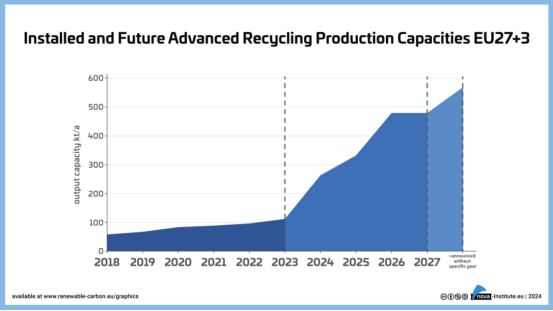
In the next five years, global capacity is expected to grow at an annual rate of 15%-20%, and is likely to exceed 2 million tons/year. This technology-driven "plastic revolution" will fundamentally reshape the relationship between humans and plastics, transforming the linear economy into a circular one and ultimately realizing the sustainable development vision of "zero waste".


