Recently, the first-of-its-kind vacuum-type pyrolysis equipment independently developed by Hunan Vary Tech Co., Ltd. was shipped from the Port of Shanghai to South Korea, where it will be deployed in a local waste-tyre resource-recovery project.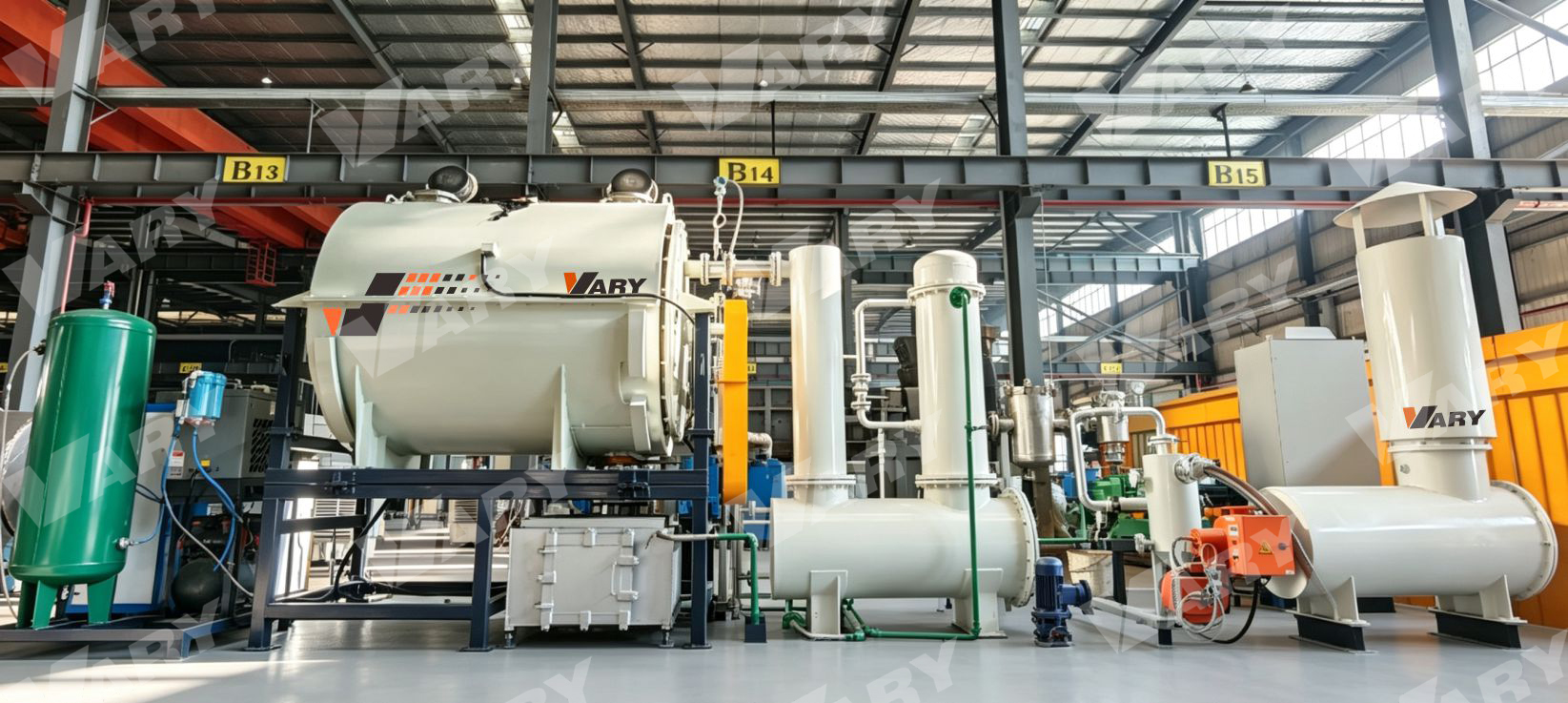
This marks another deployment of Vary Tech's pyrolysis technology in South Korea, following the market entry of its electromagnetic pyrolysis equipment in 2023. Riding on South Korea's policy tailwinds for an accelerated transition to a circular economy, Chinese circular-economy technologies are achieving deeper global expansion through differentiated customisation and core-process upgrading.
According to the European Rubber Journal, the South Korean government has launched a special R&D programme with funding of 48 billion KRW (approximately 250 million RMB) to develop high-value waste-tyre recycling technologies, helping domestic manufacturers prepare for the EU Ecodesign for Sustainable Products Regulation (ESPR), which is expected to enter into force in 2028.
According to the South Korean Ministry of Climate, Energy and Environment, more than 60% of waste tyres generated in South Korea are currently recycled into solid recovered fuel for thermal-energy applications, while only a small fraction is converted into recovered carbon black (rCB) for new-tyre manufacturing. To build a closed-loop circular system, South Korean policy explicitly requires upgrading pyrolysis technologies to raise the rCB incorporation rate to over 15%.
This mandatory target forces pyrolysis equipment to meet a critical threshold: only by consistently delivering high-quality pyrolytic carbon with high purity, well-developed pore structure and good suitability for modification and granulation can equipment effectively gain access to the South Korean market.
The exported vacuum-type pyrolysis unit is an innovative tailor-made solution developed by Vary Tech to match South Korean customers' specific site constraints, waste-tyre feedstock properties and product-quality requirements. Using electric heating, each furnace can process 200 kg of waste tyres per day.
Rather than supplying off-the-shelf standard equipment, Vary Tech leverages flexible modular configuration and systematic tuning of operating parameters to resolve practical pain points faced by local environmental enterprises, such as limited footprint and feedstock fluctuation, so that the technology can truly deliver targeted return on investment for project owners.
Vacuum carbonisation gives this custom solution its core competitive advantage. Conventional oxygen-free pyrolysis suffers from significant secondary-cracking risks. Under slightly positive or slightly negative pressure, volatiles are removed only slowly from the high-temperature reaction zone and reside there for too long. This readily triggers secondary cracking: high-value macromolecular oil and gas fractions are further decomposed into low-value non-condensable gas, or undergo polycondensation and deposit as carbon on solid-product surfaces. As a result, the yield of high-grade pyrolysis oil drops and the purity of pyrolytic carbon deteriorates.
Vary Tech's pyrolysis system rapidly reduces internal furnace pressure to approximately −95 kPa. Volatiles are instantly drawn out of the high-temperature zone by the strong pressure differential as soon as they are generated, greatly suppressing secondary-cracking reactions.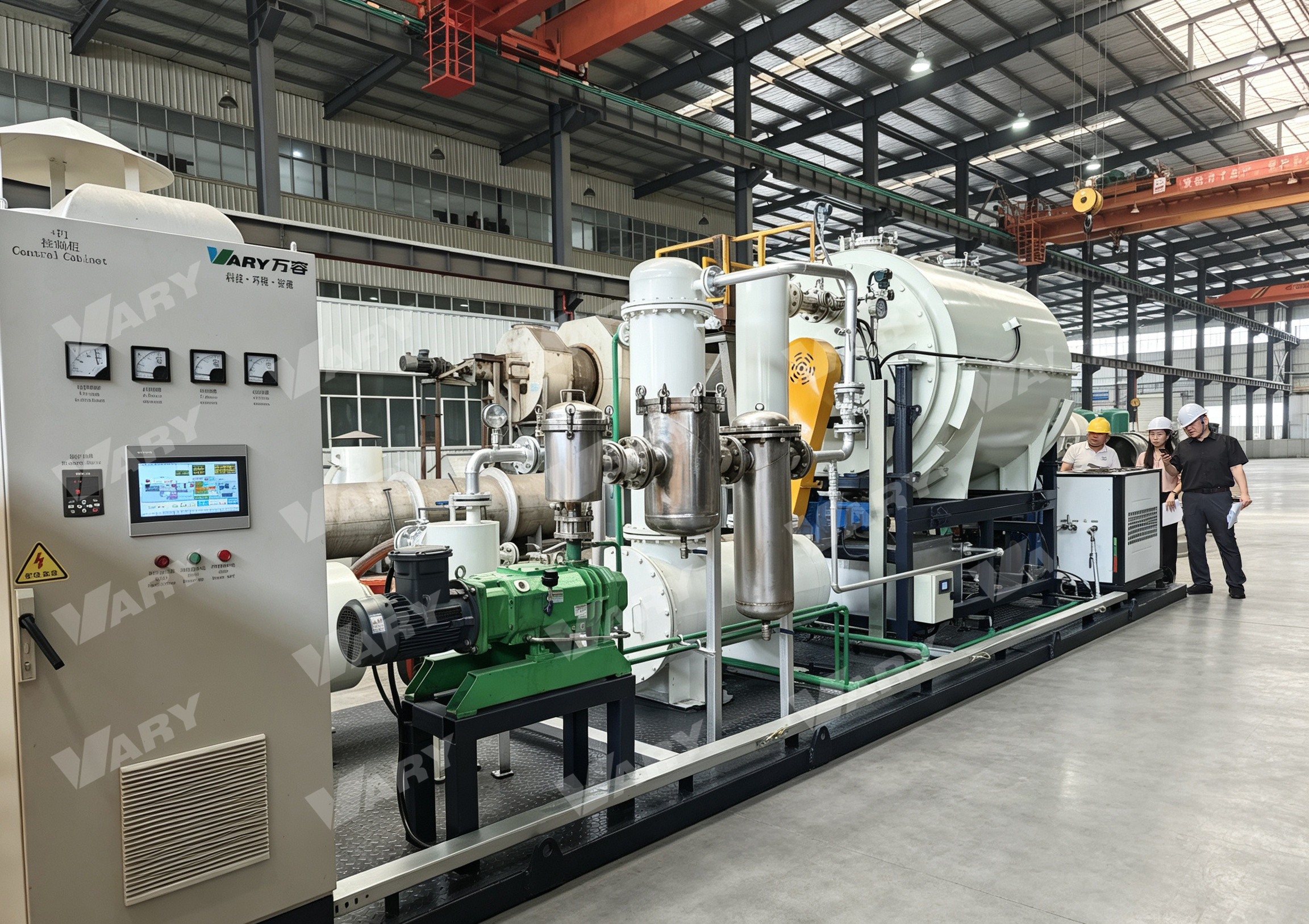
The vacuum environment effectively reduces the reaction activation energy, substantially cuts system energy consumption and improves product yields. On-site acceptance test data with real feedstock from the South Korean customer validate the performance: after vacuum pyrolysis of waste tyres, the pyrolysis-oil yield reaches 45.7%, while pyrolytic carbon accounts for 39%. The pyrolytic carbon exhibits high fixed carbon content, calorific value and energy density, along with well-developed pore structures. It satisfies downstream manufacturers' requirements for premium rCB base material for grinding, modification and granulation under South Korea's policy-driven market conditions.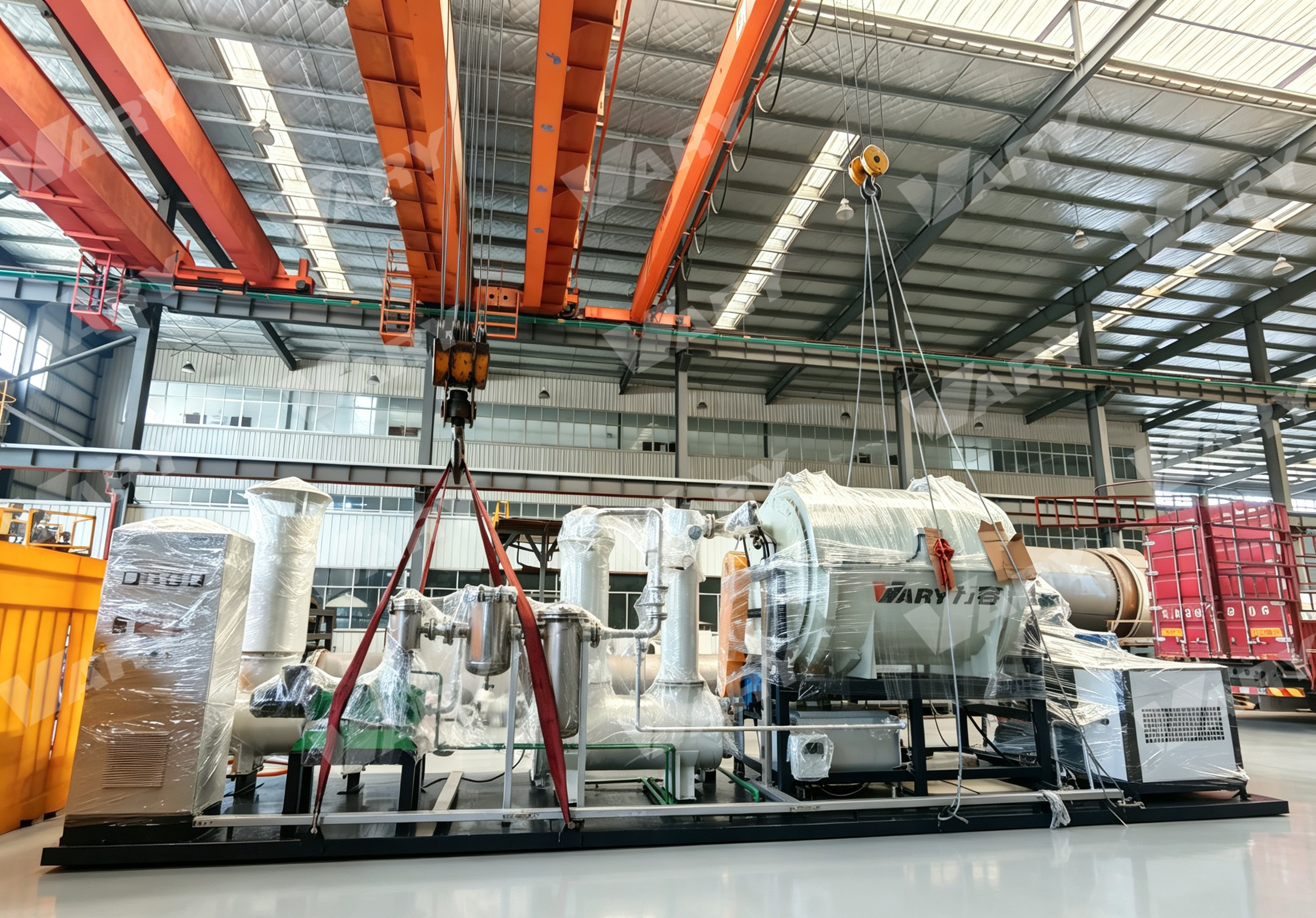
The export of this vacuum-type pyrolysis equipment represents another tangible milestone in Vary Tech's globalisation strategy and provides a new reference model for the deeper global roll-out of Chinese circular-economy technologies. It demonstrates a new profile for Chinese environmental-protection enterprises going global: tapping incremental growth in niche scenarios, capturing policy dividends through innovative technologies, and establishing global roots through local deepening and ecosystem co-building. Only in this way can enterprises accomplish the qualitative shift from "newcomers" to "long-term players" amid the global green-transition wave.

